An IBS food and symptom diary is a daily record of what you eat and drink, when, and how your gut responds, kept long enough to show repeating patterns rather than one-off bad days. To reveal real triggers, it needs portion sizes and times, symptom severity and timing, and stool form. It also needs the non-food factors that move IBS symptoms, such as sleep, stress and the menstrual cycle.
Why keep an IBS food and symptom diary?
Most people with IBS link at least some symptoms to food. In a Swedish study, 84% of patients named at least one food that caused symptoms.[1] In an Irish survey, 92% had changed their diet to manage symptoms, some cutting out whole food groups, and few had sought professional advice.[2] Hunches like these can be right, but they can also be wrong, and cutting foods unnecessarily risks nutritional gaps.[2]
A diary turns hunches into evidence you can check. Dietitians use food diaries to assess IBS before recommending a diet.[3][4] In a US study, people with IBS found paper food and symptom journals practical to keep. Most showed a strong link between at least one symptom and a meal component, and those links differed from person to person.[5]
What should you record in an IBS food diary?
| Record | What to note | Why it matters |
|---|---|---|
| Food and drink | Everything, including sauces, drinks and snacks; for mixed dishes, the main ingredients | Triggers such as garlic and onion often hide in sauces and stocks[6] |
| Amount | Rough portion: small, medium, large, or household measures | Whether a food counts as low or high FODMAP depends on the serving size[7][4] |
| Time | When you started eating | Lets you line up symptoms with meals |
| Symptoms | Type (pain, bloating, gas, diarrhea, constipation, fatigue), severity from 0 to 10, onset time and duration | Clinicians assess symptom onset, duration, frequency, severity and pattern[3] |
| Stool form | Bristol Stool Form Scale type (1–7) and frequency | Stool form is a validated, simple guide to how fast stool moves through the gut[8] |
| Sleep | Hours and quality | Poorer sleep predicted next-day abdominal pain in women with IBS[9] |
| Stress | A quick 0–10 rating and any major events | Stress affects gut sensitivity and motility and can trigger flare-ups[10] |
| Menstrual cycle | Cycle day, if relevant | Pain and bloating often worsen around menstruation[11][12] |
| Alcohol, caffeine, medicines | What and how much | Heavy drinking was linked to next-day symptoms[13] |
Our Bristol stool chart guide shows how to score stool form consistently.
How long after eating do IBS symptoms start?
It depends on what you ate, which is why "the last thing I ate" is often the wrong suspect. In MRI studies, fructose pulled water into the small intestine, while inulin, a fructan, distended the colon with gas. In people with IBS who were watched for five hours after each drink, symptoms peaked sooner after fructose than after inulin.[14][15] Fat works differently: after a fatty meal, gut sensitivity in people with IBS rose progressively over the following hour.[16] Some effects show up only the next day. Binge drinking was followed by next-day diarrhea and stomach pain,[13] and a poor night's sleep by more abdominal pain the next day.[9]
In practice, look at what you ate over the previous several hours, not just the last meal, and check the day before for alcohol and sleep.
Why a single bad day can mislead you
- Confounding. Bad days rarely have just one cause. A late night, a stressful meeting, your period and a big, rich meal can all land on the same day, and each one affects IBS symptoms independently.[9][10][11][16] Blaming whichever food you happened to eat last is easy, but often wrong.
- FODMAP stacking. FODMAP symptoms depend on dose,[17] and your response depends on the total FODMAP load of a meal, not on any single ingredient.[3] Several foods that are each fine in a normal serving can add up to a high load, especially in larger portions.[4] So a reaction to a mixed meal says little about any one food in it.
- Expectation (the nocebo effect). Expecting a food to hurt can produce real symptoms. In blinded gluten-challenge trials, only 16% of people with suspected gluten sensitivity reacted specifically to gluten, and a large share reacted just as strongly to placebo.[18] FODMAP challenges are prone to the same effect.[3]
- Day-to-day variation. Your tolerance of the same food can vary from week to week with stress and lifestyle.[3] One reaction is a clue, not a verdict.
How to analyze your food diary
- Collect enough data first. Two weeks is a sensible minimum. Clinical trials use 14 days of stool diaries to classify IBS subtypes.[3]
- Look for repeats. A real trigger should be followed by symptoms most times you eat it, more so in larger amounts, and not on days you avoid it.
- Group foods by FODMAP type, not by dish. Garlic in a pasta sauce and garlic in a curry are the same suspect. See common IBS trigger foods for the main groups.
- Check the non-food columns before you blame a food. Did symptoms cluster around poor sleep, stress or your period?
- Confirm with a structured test. Patterns in a diary are hypotheses. The way to confirm one is a planned challenge, as in FODMAP reintroduction. App-guided self-experiments have proved feasible for IBS, though fitting rigorous tests into everyday life is a real challenge.[19]
- Share it. A summarized diary makes appointments with your doctor or dietitian more productive.
How long should you keep an IBS food diary?
Keep it for at least two weeks before you change anything, to set a baseline. Then keep it through the elimination phase, which usually lasts a few weeks, and through reintroduction, which one clinical model plans over about 6–10 weeks.[3] After that, lighter tracking is usually enough. Start a detailed diary again if your symptoms change or when you retest a food.
Can a photo-based AI food diary make it easier?
The hardest part of a food diary is keeping it up. Image-based food records, where a photo of each meal serves as the main record, fit more easily into daily routines. In studies, adding photos reduced the under-reporting common with traditional food records.[20] AI can go a step further by suggesting the dish, its ingredients and their likely FODMAP content, but it can misjudge hidden ingredients, so check and correct its suggestions.
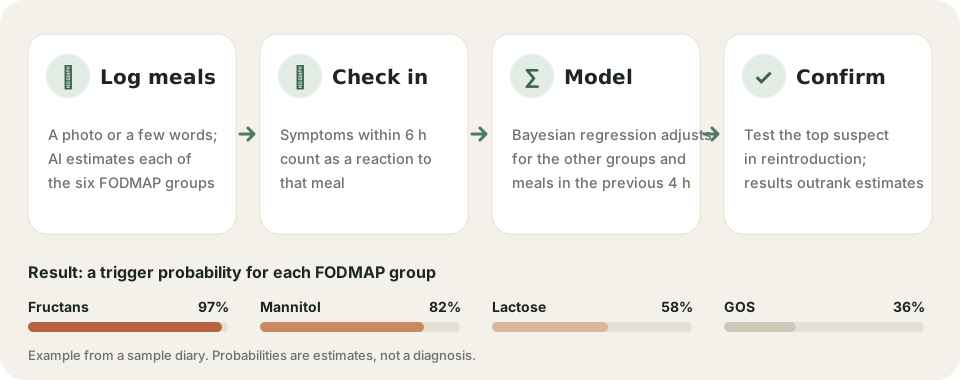
IBS Clue is one example. You photograph or type a meal, and the app identifies the dish and its ingredients, including hidden ones such as garlic and onion in sauces, and estimates its level in each of the six FODMAP groups. Quick check-ins record symptoms and Bristol stool type. The app's "Suspects" view then ranks the FODMAP groups most likely to be your triggers. It counts symptoms within six hours of a meal as a possible reaction and adjusts for the other FODMAP groups and for stacking from meals in the previous four hours. These are probabilities, not a diagnosis, and results from structured reintroduction outrank them.