The low-FODMAP diet is a three-phase eating plan for irritable bowel syndrome (IBS): you cut back on a group of fermentable carbohydrates for a few weeks, reintroduce them one type at a time to find your personal triggers, then settle into the least restrictive diet that keeps symptoms under control. In clinical trials, 50–80% of people with IBS get symptom relief from the first phase.[1]
What are FODMAPs?
FODMAPs — fermentable oligosaccharides, disaccharides, monosaccharides and polyols — are short-chain carbohydrates that are poorly absorbed in the small intestine. They fall into six groups:[1]
- Fructans (oligosaccharides) in wheat, rye, onion and garlic. Humans have no enzyme to break them down.
- Galacto-oligosaccharides (GOS) in beans, lentils and other pulses. These aren't digested either.
- Lactose, the sugar in milk. You need the enzyme lactase to absorb it, and in many people lactase activity naturally declines after infancy, to a degree that varies by ethnic background.
- Excess fructose: fructose present in greater amounts than glucose, as in mango and honey. It's absorbed incompletely in some people.
- Sorbitol and mannitol, two polyols (sugar alcohols) found in some fruits and vegetables. Sugar alcohols are also used as sweeteners in sugar-free products. They're absorbed only partly.[2]
Why do FODMAPs cause IBS symptoms?
FODMAPs act in two ways. In the small intestine, they draw in water: on MRI scans, a fructose drink visibly increased the water content of the small bowel. Whatever reaches the colon is then fermented by gut bacteria, which produces gas; inulin, a fructan, distended the colon with gas.[3]
Here's the key point: people with IBS don't necessarily make more gas or water than anyone else. In a study comparing people with IBS and healthy volunteers, both groups had similar MRI findings after fructose or inulin, but the IBS group reported more symptoms. That points to a gut that is more sensitive to stretching (visceral hypersensitivity) rather than to "bad" digestion.[4] The low-FODMAP diet works by lowering the load on that sensitive gut. High-FODMAP foods are unlikely to harm you beyond causing symptoms.[1]
FODMAP list: which foods are high and low in FODMAPs?
The table shows common examples, not a complete list. It's built from published FODMAP research.[1][5][6][2]
| FODMAP group | Common high-FODMAP foods | Lower-FODMAP swaps |
|---|---|---|
| Fructans | Wheat- and rye-based bread, pasta and cereals; onion, garlic, leek, shallots, artichoke | Rice, oats, corn, gluten-free bread and pasta; chives, green tops of spring onions |
| GOS | Lentils, chickpeas, kidney beans, broad beans, pistachios, silken tofu | Firm tofu, eggs, meat, poultry, fish, peanuts |
| Lactose | Cow's milk, yogurt | Lactose-free milk and yogurt, hard cheeses such as cheddar |
| Excess fructose | Mango, honey, figs, watermelon, large glasses of fruit juice, high-fructose corn syrup | Kiwifruit, blueberries, citrus fruits |
| Sorbitol | Apples, pears, stone fruits such as apricots, sugar-free gum and mints | Kiwifruit, blueberries, citrus fruits |
| Mannitol | Mushrooms, cauliflower | Carrot, spinach, green beans, bell pepper, potato |
Portion size matters. A food is classed as low or high FODMAP based on a typical serving,[7] and a larger portion can tip a low-FODMAP food into the high range.[6] FODMAP content also varies with processing and ingredients from country to country, so up-to-date, lab-tested food data beats an old printed list.[7] Garlic and onion are the hardest to spot because they hide in sauces, stocks and spice mixes; see why garlic and onion trigger IBS.
The three phases of the low-FODMAP diet
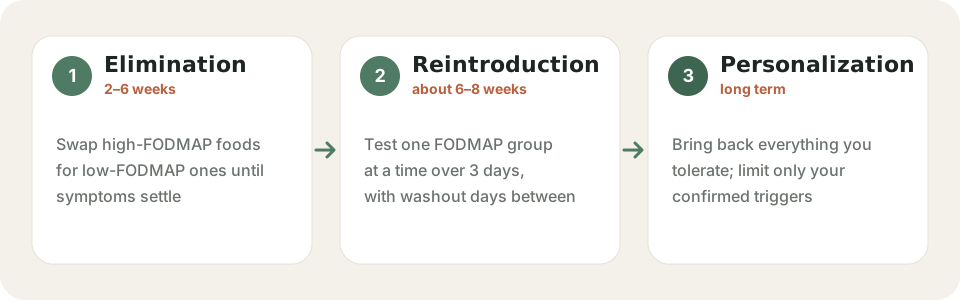
1. Elimination (restriction)
You swap high-FODMAP foods for low-FODMAP alternatives across all six groups. This phase usually lasts 2 to 6 weeks. Trials of strict restriction have run for up to six weeks, and about four weeks is enough for most people to see whether it helps.[1] Many people notice a difference within 1–2 weeks, though some take 3–4.[8] If you stuck to the diet carefully and nothing improved, it has failed. Stop it and talk to your doctor about other treatments; don't keep restricting.[1]
2. Reintroduction (challenge)
If your symptoms improved, you test one FODMAP group at a time, eating a test food in increasing amounts over about three days while keeping the rest of your diet low in FODMAPs.[1] Our FODMAP reintroduction guide walks through it step by step.
3. Personalization
You bring back everything you tolerated and limit only your own triggers, to the amounts you handle well. Tolerance can change, so it's worth retesting foods that caused trouble from time to time.[6] The long-term results are encouraging. In one UK clinic, 57% of patients still had satisfactory symptom relief after reintroduction, compared with 12% before the diet.[9] In another group, two-thirds reported adequate relief after 12 months on a personalized diet.[10]
Does the low-FODMAP diet work? What the evidence says
- Halmos et al., 2014. In an Australian crossover trial where almost all food was provided, 30 people with IBS had roughly half the overall symptom score on a low-FODMAP diet compared with a typical Australian diet (22.8 vs 44.9 on a 100-mm scale). Bloating, pain and wind all improved.[11]
- Staudacher et al., 2017. This UK trial of 104 people compared the diet with a sham diet that was just as hard to follow. After four weeks, IBS symptom severity scores were significantly lower on the low-FODMAP diet. The difference in how many people reported "adequate relief" (57% vs 38%) narrowly missed statistical significance in the main analysis.[12]
- Böhn et al., 2015. In a Swedish trial of 75 patients, the low-FODMAP diet worked about as well as traditional IBS dietary advice: 50% vs 46% of patients had a meaningful drop in symptoms.[13] Simpler advice is therefore a reasonable first step.
- Black, Staudacher and Ford, 2022. This network meta-analysis pooled 13 randomized trials (944 patients). The low-FODMAP diet ranked first of the diets studied for global symptoms, abdominal pain and bloating, and it beat standard British dietary advice for bloating. Most trials were done in specialist clinics, though, and few studied the reintroduction phase.[14]
- Cuffe et al., 2025. An updated network meta-analysis of 28 trials (2,338 patients) concluded that the most evidence exists for the low-FODMAP diet, while other diets show early promise.[15]
The two major guidelines agree. The American College of Gastroenterology (ACG) recommends a limited trial of the diet to improve global IBS symptoms.[16] The British Society of Gastroenterology (BSG) places it second-line, after general dietary advice. The BSG also says it should be supervised by a trained dietitian, with FODMAPs reintroduced according to tolerance.[17]
Who shouldn't start a low-FODMAP diet on their own?
- Anyone without a diagnosis. IBS symptoms overlap with celiac disease, inflammatory bowel disease and bowel cancer, so a doctor should confirm IBS first. Get tested for celiac disease while you're still eating gluten.[1] See a doctor promptly if you notice warning signs: blood in your stool, unintentional weight loss, anemia, bowel movements that wake you at night, a family history of bowel cancer or IBD, or new symptoms after about age 50.[18]
- People with an eating disorder, or at risk of one. Anyone with an active eating disorder shouldn't be put on a FODMAP diet or any other restrictive diet.[6]
- Children, teenagers, and people who are pregnant or breastfeeding. Dietitians often prefer a gentler approach that restricts only a few very high-FODMAP foods.[5]
- People who already eat restrictively, such as vegans and people with diabetes or inflammatory bowel disease. These groups need individual dietitian input.[5][6]
Why the low-FODMAP diet isn't meant to be lifelong
Several FODMAPs, especially fructans and GOS, are prebiotics: they feed beneficial gut bacteria such as bifidobacteria.[1] Restricting them lowers bifidobacteria in the gut. Staudacher and colleagues found this after four weeks in 2012[19] and again in a larger placebo-controlled trial in 2017.[12] What this means for long-term health is still unclear. Some researchers point out that no harm from the drop has been shown,[20] and bifidobacteria were back at baseline levels in people who had moved on to a personalized diet for a year.[10]
There are practical reasons, too. Strict long-term restriction can lead to nutritional shortfalls,[6] with fiber and calcium most at risk,[1] and it makes eating out and social meals harder. Reintroduction is what turns a short experiment into a sustainable way of eating.
Why a registered dietitian makes a difference
Almost all the trials that proved the diet works used dietitian-led education.[1] A real-world study shows why that matters. Among patients who tried the diet, those guided by a dietitian followed the elimination phase correctly far more often (96% vs 71%), did the reintroduction phase properly more often (70% vs 39%), and moved on to a personalized diet more often (65% vs 29%).[21] A dietitian can also check that your diet stays nutritionally complete, adapt it to your cuisine, and screen for disordered eating.[6]
If you can't see a dietitian right away, keep a careful food and symptom record from day one. It shows whether elimination helped and makes reintroduction easier to judge. Our IBS food diary guide explains what to record, and an app such as IBS Clue can estimate the FODMAP content of each meal from a photo and guide you through all three phases.