The Bristol Stool Form Scale, often called the Bristol stool chart, sorts stool into seven types, from separate hard lumps (type 1) to watery stool with no solid pieces (type 7). Lower numbers generally mean stool has moved slowly through your gut, and higher numbers mean it has moved quickly, so the scale is a simple stand-in for transit time. Doctors use it to classify IBS into constipation, diarrhea and mixed subtypes.[1][2]
What are the 7 types on the Bristol stool chart?
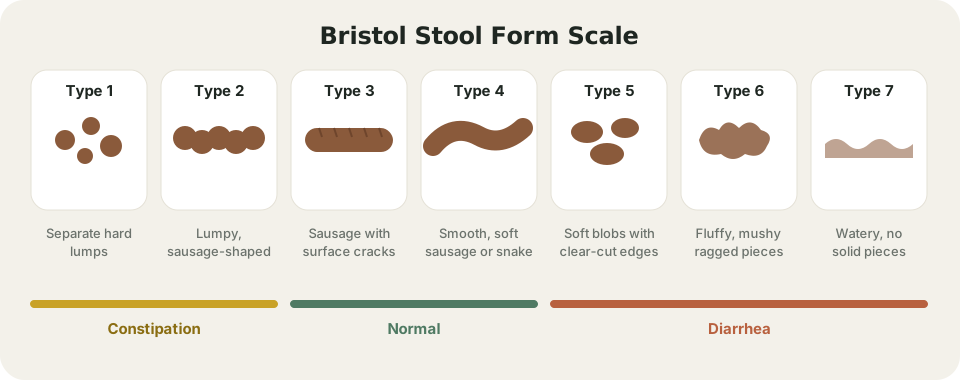
| Type | Description | What it usually suggests |
|---|---|---|
| 1 | Separate hard lumps, like nuts | Hard stool and slower transit. Counted as abnormal (hard) in Rome IV |
| 2 | Sausage-shaped but lumpy | Hard stool and slower transit. Counted as abnormal (hard) in Rome IV |
| 3 | Like a sausage but with cracks on the surface | Middle of the scale |
| 4 | Like a sausage or snake, smooth and soft | Middle of the scale |
| 5 | Soft blobs with clear-cut edges | Middle of the scale, toward the softer end |
| 6 | Fluffy pieces with ragged edges, a mushy stool | Loose stool and faster transit. Counted as abnormal (loose) in Rome IV |
| 7 | Watery, no solid pieces | Watery stool and faster transit. Counted as abnormal (loose) in Rome IV |
The "abnormal" labels come from the Rome IV rules for subtyping IBS, which look only at types 1–2 and types 6–7.[2][3] Types 3 to 5 don't push you toward either subtype.
What does your stool type say about gut transit time?
Whole-gut transit time is how long food residue takes to travel from mouth to toilet. One standard way to measure it is to swallow small markers that show up on an X-ray, which isn't practical day to day. The Bristol scale offers a simpler route, because stool form turns out to be a reasonable proxy.[1]
In Lewis and Heaton's 1997 study, 66 volunteers had their transit time measured with radiopaque marker pellets and kept a diary of stool form and frequency:[1]
- At baseline, transit time correlated better with stool form (r = −0.54) than with how often people went (r = 0.35) or with the weight of stool passed (r = −0.41).
- When volunteers took the laxative senna, transit sped up and stool form scores went up. With loperamide, an anti-diarrheal, everything moved the other way.
- Changes in stool form tracked changes in transit time best of all (r = −0.65).
The takeaway is that a shift in your usual stool type is more informative than a change in how often you go. The correlation is moderate, though, not perfect, so the scale shows a tendency rather than measuring transit exactly.
A 2016 validation study added two useful findings. People's ratings correlated with the measured water content of their stools, and healthy volunteers averaged 3.7 on the scale, compared with 5.0 for people with IBS with diarrhea (IBS-D). Overall, 81% of stool models were classified correctly, but fewer than 80% of types 2, 3, 5 and 6 were, so the in-between types are the hardest to rate consistently.[5]
How is the Bristol scale used to classify IBS subtypes?
Under the Rome IV criteria, once IBS is diagnosed, your subtype depends on how your abnormal stools split between the hard and loose ends of the scale.[2][3][4]
| Subtype | Rome IV rule |
|---|---|
| IBS-C (constipation) | More than 25% of bowel movements are type 1 or 2, and fewer than 25% are type 6 or 7 |
| IBS-D (diarrhea) | More than 25% are type 6 or 7, and fewer than 25% are type 1 or 2 |
| IBS-M (mixed) | More than 25% are type 1 or 2 and more than 25% are type 6 or 7 |
| IBS-U (unclassified) | Meets the IBS criteria but doesn't fit any of the patterns above |
The ACG adds three practical rules. Judge your stool consistency only on days when you report abnormal bowel movements. Do it while you are off treatments that could affect your bowel pattern, such as laxatives or anti-diarrheals. And keep daily diaries for 2 weeks for the most accurate assessment.[3]
Getting the subtype right matters, because most IBS medicines were developed for one specific subtype. The ACG warns that the wrong subtype could lead to treatment that makes symptoms worse.[3] For the full IBS criteria, see what is IBS.
A worked example: say you log 20 bowel movements over two weeks. Eight are type 6 or 7 (40%), two are type 1 or 2 (10%), and the rest are types 3–5. Loose stools are above 25% and hard stools below 25%, so the pattern fits IBS-D, provided you also meet the IBS pain criteria.
How do you log your stools on the Bristol scale?
- Record every bowel movement soon after it happens. Write down the type number (1 to 7) and the time. Memory blurs quickly.
- If you're between two types, pick the closer one and move on. In testing, volunteers found types 2, 3, 5 and 6 the hardest to classify.[5] Being consistent matters more than being perfect.
- Add a little context: urgency, straining, pain before or after, a feeling of incomplete emptying, and any laxatives or anti-diarrheals you took.
- Keep it going for at least two weeks before a doctor's appointment. That's the period the ACG suggests for judging your subtype.[3]
- Pair it with what you ate and how you felt. Stool type alongside a food and symptom diary is far more useful than either alone.
IBS Clue, an iPhone app coming soon, includes a Bristol stool log alongside quick symptom check-ins, and can export the record as a PDF report for your doctor.
What doesn't the Bristol stool chart tell you?
- Blood or color. The scale describes shape and consistency only. Red blood in the stool or black, tarry stools are alarm features that need a doctor, whatever the stool type.[3] See IBS red flags.
- A diagnosis. Stool type alone can't diagnose IBS. Rome IV also requires recurrent abdominal pain linked to bowel movements.[2][3]
- The effect of medicines. Laxatives and anti-diarrheals shift your stool type, which is why subtyping is done off them.[3]