Whether a meal is low FODMAP depends on more than what's on the plate. FODMAP levels change with processing, ripeness and serving size, and many foods are fine in one amount but not in a larger one.[1] A photo shows the dish, not the recipe or the weight, so any app that reads photos is making an informed estimate. That can still be very useful, as long as the app is honest about it.
What can AI tell from a photo of your meal?
- What the dish is. In a 2025 study, ChatGPT identified the foods in 114 meal photos with 93% precision.[2]
- Likely ingredients, including hidden ones. A model that knows how a dish is usually cooked can flag garlic in a marinade or onion in a stock. Garlic and onion are among the richest sources of fructans,[3] the most common trigger in a blinded reintroduction study.[4] See garlic, onion and fructans.
- An estimate for each FODMAP group. Ingredients can be mapped to the six FODMAP groups — fructans, galacto-oligosaccharides (GOS), lactose, excess fructose, sorbitol and mannitol — and combined into a level for the whole meal.[5]
Where AI photo analysis falls short
- Portions. FODMAP effects depend on the dose, and portion size is where AI is weakest. In the same 2025 study, ChatGPT estimated the weight of small meals reasonably well but not of medium or large ones.[2] In another, ChatGPT and Claude misjudged food weight by about 36–37% on average, Gemini did worse, and all three underestimated portions more as they got bigger.[6]
- Recipe details a camera can't see. Firm tofu is low FODMAP and silken tofu isn't, because of how they're processed, and a photo or a chatbot can easily miss that.[1] Recipes and brands differ between countries too: in the US, high-fructose corn syrup may push up excess fructose in some processed foods.[5]
- Ripeness and preparation. The same fruit can test differently as it ripens.[1]
As Monash University's dietitians put it, without laboratory data, AI "is just making an educated guess."[1]
Lab-tested data vs AI estimates
Monash University's FODMAP research team measures FODMAPs in foods in its own laboratory, using techniques such as high-performance liquid chromatography.[1] Its cutoffs for "low" are based on the FODMAP content of typical servings, set by comparing foods that commonly trigger symptoms with foods that are usually well tolerated.[5] That makes lab-tested data the reference for single foods. AI estimates fill a different gap: mixed dishes, restaurant meals and home cooking that no food list covers.
| Lab-tested data | AI estimate from a photo or description | |
|---|---|---|
| Where the number comes from | Laboratory measurement of the food[1] | Inferred from the dish and its usual ingredients |
| Best for | Single foods and products at a stated serving | Mixed, restaurant and home-cooked meals |
| Portion | Rated at specific serving sizes[5] | Estimated, and least reliable for large portions[6] |
| Hidden ingredients | Only if you know they're there | Can flag likely ones, such as garlic, onion or wheat |
| How to use it | To check a specific food | As a starting estimate that you check and correct |
Is "low FODMAP" even the right question?
Not for long. The low-FODMAP diet has three stages: restricting FODMAPs, reintroducing them to find the ones that trigger your symptoms, and then a personalized diet that limits only those.[7] Guidelines recommend that a trained dietitian supervise it.[8]
Triggers are personal. In a blinded reintroduction study, people with IBS reacted to an average of 2.5 FODMAP types, most often fructans and mannitol, in a pattern that differed from person to person.[4] So the more useful question isn't just "is this meal low FODMAP?" but "which FODMAPs trigger me, and how much can I eat?" Answering it takes a food and symptom diary and a structured reintroduction.
What to look for in a low-FODMAP app
- It estimates all six FODMAP groups, not a single "gut score".
- It flags likely hidden ingredients and lets you correct them.
- It lets you set your portion and scales the estimate to it.
- It's clear that its levels are estimates.
- It links meals to the symptoms you log, allowing for timing and for FODMAPs adding up across meals.
- It guides reintroduction, so suspected triggers get tested rather than just avoided.
- It screens for warning signs and tells you when to see a doctor.
- It asks before sending your meals to an AI service.
Our fuller checklist, and how chatbots compare with dedicated apps, is in AI tools for IBS.
How IBS Clue handles it
IBS Clue is an iPhone app, coming soon to the App Store, that we built around that list. You photograph a meal or type it in. The AI identifies the dish and its ingredients, marks the ones likely to be hidden, such as garlic and onion in a sauce, and estimates the meal's level in each of the six FODMAP groups. Those levels are AI estimates, not lab measurements, and they can be wrong, especially for unfamiliar dishes. So you can tap any ingredient to correct or remove it, set the portion, and have the meal analyzed again.
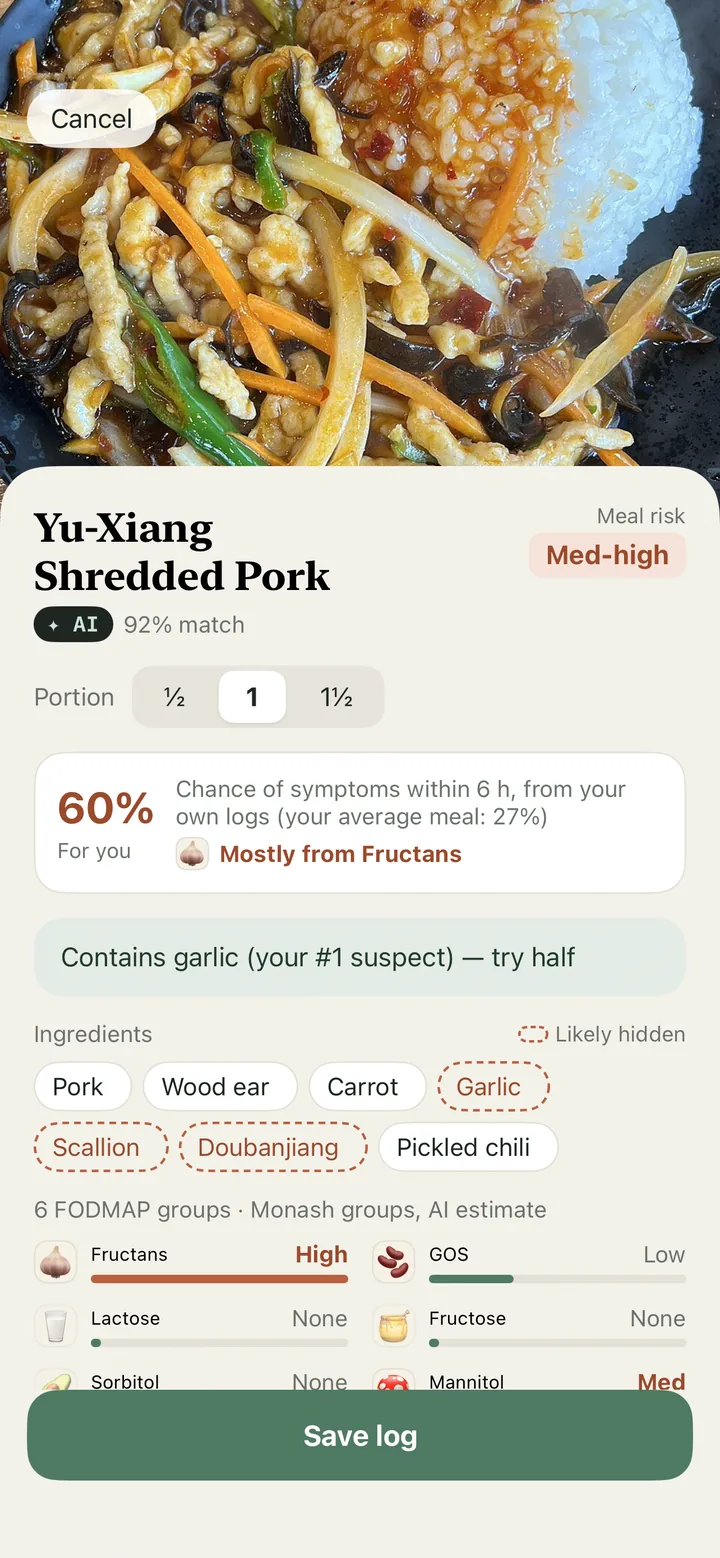
The estimate is only the starting point. You log quick symptom check-ins and your stool form, and the app's Suspects view ranks the FODMAP groups most likely to be your triggers. A symptom within 6 hours of a meal counts as a reaction, and a Bayesian logistic regression adjusts for the other groups and for FODMAPs stacking up from meals in the previous 4 hours, giving a probability for each group. A guided reintroduction then tests each group directly, and those results outrank the statistics.
The app is free, with an optional Pro subscription; your first 10 AI meal analyses are free. There's no account, your diary stays on your phone, and meals are sent to the AI only after you consent. It's a self-tracking tool, not a medical device, and it doesn't diagnose or treat.